Science China Press
The origin of lives of human beings, animals and plants on earth is attributed to chirality because it is necessitated for the formation of biomolecules, such as nucleic acids, proteins, carbohydrates, etc. The studies on chirality have been becoming increasingly active and extensive due to its importance in chemistry, material sciences and pharmaceuticals in regard to developing new drugs with higher potency and fewer/less side-effects. So far, there have been four main types of general chirality revealed in scientific community: element central, axial/helical, spiro and double planar chirality; the first three exist in nature and the last chirality are artificially rendered in labs. The last chirality involves the structural unit of ferrocene which was invented by Nobel Laureate, G. Wilkinson at Imperial College London and chiral ferrocene developed by Cal Tech chemist G. Fu.
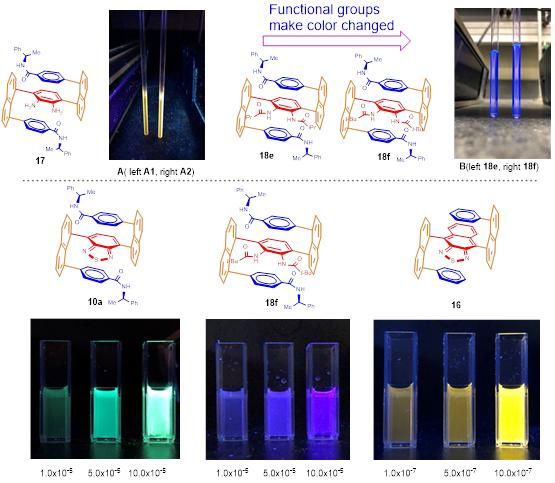
There is a recent report on the fifth chirality of multi-layer 3D chirality of C2- and/or pseudo C2-symmetry and on its first chemical synthesis by Professor Guigen Li's labs at Texas Tech University and Nanjing University in collaboration with Professor Tao Jiang at Ocean University of China. As confirmed by X-ray structural analysis that almost parallel arrangement consisting of three layers: top, middle and bottom layers, exists in this multi-layer 3D chirality. It shows the top and bottom layers restrict each other from free chemical bond rotation, i.e. if either top or bottom layer is removed, this chirality would not exist due to the resulting racemization. Therefore, the new 3D chirality is differentiated from any documented planar or axial chirality.
Retro-synthetic analysis (RSA) established by Nobel Laureate, E. J. Corey at Harvard and the Suzuki-Miyaura cross coupling invented by Nobel Laureate, A. Suzuki and his coworker N. Miyaura in Japan played important roles in the discovery and synthesis of the multi-layer 3D chirality of C2-symmetry. Double cross-couplings invented by S. Buchwald at MIT and J. Hartwig at UC Berkeley enabled assembling multi-layer 3D chirality of pseudo C2-symmetry.
It is very intriguing that the resulting chiral multi-layer 3D products displayed macro chirality phenomenon which can be directly observed by human eyes without an aid of microscopic devices. When solutions containing 3D samples were slowly evaporated by being exposed to air for a few days, anti-clockwise spiral loops were formed in glass containers. These spiral loops shine with green color when it is irradiated under UV light at 365 nm. It is also very interesting when a capped NMR tube containing a CDCl3 solution of a 3D compound was stored at room temperature for over several weeks, right-handed spiro textile-shaped solids were formed inside NMR tubes. Nearly all 3D products displayed strong fluorescence even in their solid forms under UV light at 365 nm.
The change of functional groups in multi-layer 3D chiral molecules led to their luminescence color changes from gold color to dark green. They also displayed strong aggregation-induced emission (AIE) in which the higher fraction of water, the stronger the luminescence has been confirmed qualitatively and quantitatively. Several of such 3D molecules have showed unusually high optical rotation, indicating their great potential serving for optical material science and technology.
Enantioselective assembly of multi-layer 3D chirality
Wu G, Liu Y, Yang Z, Katakam N, Rouh H, Ma L, Tang Y, Ahmed S, Rahman AU, Huang H, Unruh D, Li G
National Science Review 16 December 2019
DOI: 10.1093/nsr/nwz203
Contact information:
Gregory C. Fu
Professor of Chemistry at Caltech
gcfu@caltech.edu
Phone: 626-395-2481
Guigen Li
Professor of Chemistry and Biochemistry at Texas Tech University
guigen.li@ttu.edu
Phone: 806-834-8755
Tao Jiang
Professor of Medicinal Chemistry & Pharmaceutical Engineering at Ocean University of China
jiangtao@ouc.edu.cn
Phone: 0532-82032712
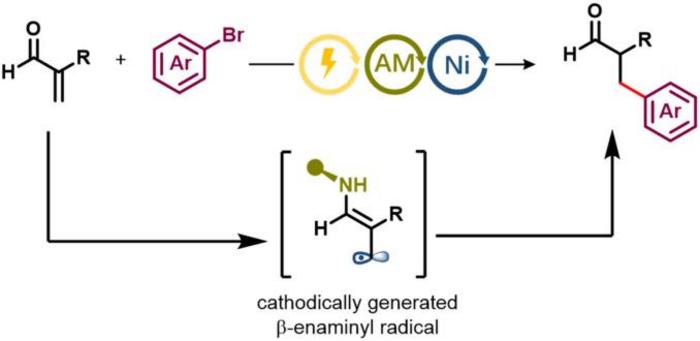
A primary amine and nickel dual catalytic system uses electrochemistry to reverse the usual reactivity of aminocatalytic intermediates, reducing an iminium ion at the cathode to a β-enaminyl radical instead of oxidizing an enamine. Run at 1.10 V with an inexpensive achiral amine, the method couples α-branched acroleins with aryl and alkenyl halides, giving β-functionalised aldehydes in up to 91% yield and 80% on gram scale.
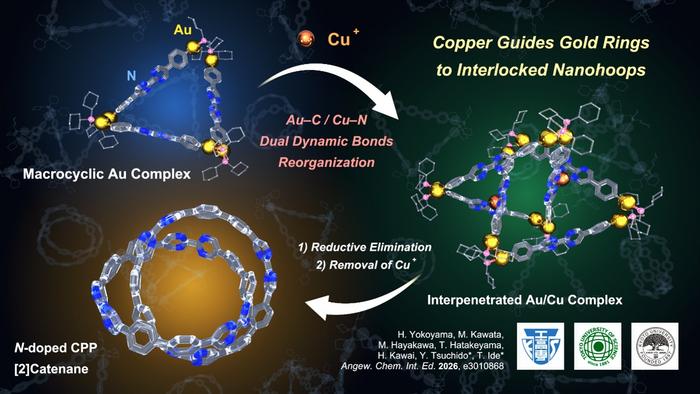
Researchers in Japan have combined gold(I) carbon bonds and copper(I) nitrogen coordination to assemble an interlocked catenane of nitrogen-doped carbon nanohoops in a single pot. Demetallation gave a metal-free [2]catenane of two fully conjugated [12]CPP rings in only eight steps, with a 2.9% overall yield that improves on conventional routes.
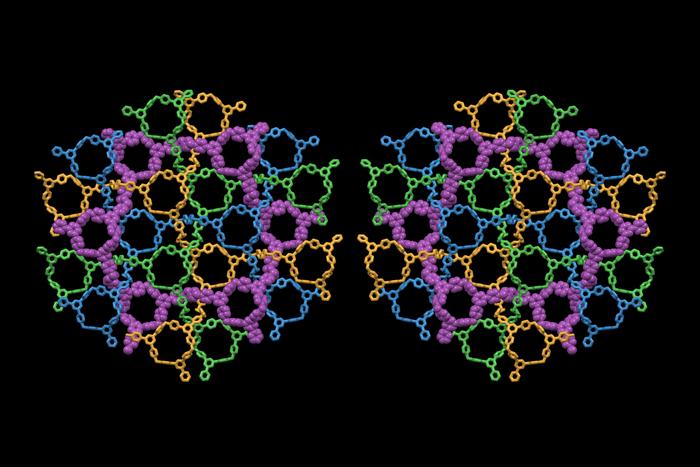
Chemists at UT Austin and Zhejiang University have developed a self-assembling molecularly woven fabric that separates benzene from cyclohexane far more efficiently than distillation, whose near-identical boiling points make conventional processing costly. Stacked layers of clockwise and counterclockwise chiral networks form a springy, reusable filter that absorbed 97.9% of benzene from a 50/50 mixture.
This week in nanotech
18 deals tracked
New products
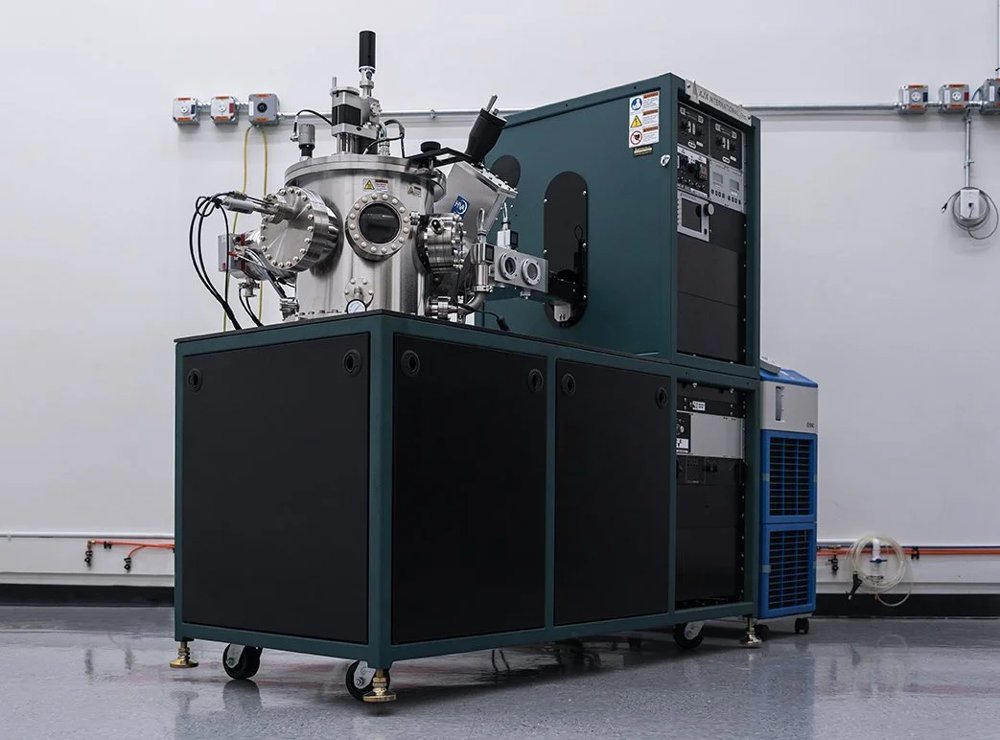 Orion Sputtering Deposition SystemsAJA International Featured
 Nion-compatible In Situ STEM Holders for Electrical BiasingHummingbird Scientific Featured
 GiiiGii
Market insights
Last 30 days: Semiconductors & Electronics was the busiest vertical: 54 of 168 events (32%).
Money raised per month